Watch Guide
Watch Terms Glossary: Every Word Explained in Plain English (2026)
 By Sofia Leen
·
Watch Guide
·
14 min read
By Sofia Leen
·
Watch Guide
·
14 min readThis post may contain affiliate links. If you purchase through one, we may earn a small commission at no extra cost to you.
Somewhere between “case diameter” and “milanese mesh,” most product descriptions stop making sense — and it’s not because the watch is complicated. It’s because the industry writes for people who already speak the language.
This happens constantly to shoppers with small wrists, because the terms that matter most to you — lug-to-lug, case thickness, strap taper — are often the exact terms brands explain the least. A spec box might list a 38mm case, a Swiss quartz movement, and a sapphire crystal, and stop right there — leaving you to guess whether any of that adds up to a watch that actually sits well on a 14cm (5.5in) wrist. It doesn’t, not without knowing what those words mean and why they matter for fit.
This watch terms glossary exists so you never have to guess again. Every term is grouped by what it actually affects — sizing, comfort, durability, or style — with a plain explanation of why it matters if your wrist is on the smaller side. Bookmark this page; we’ll link back to it from every guide and review on the site.
Section 1
Case & Dimension Terms
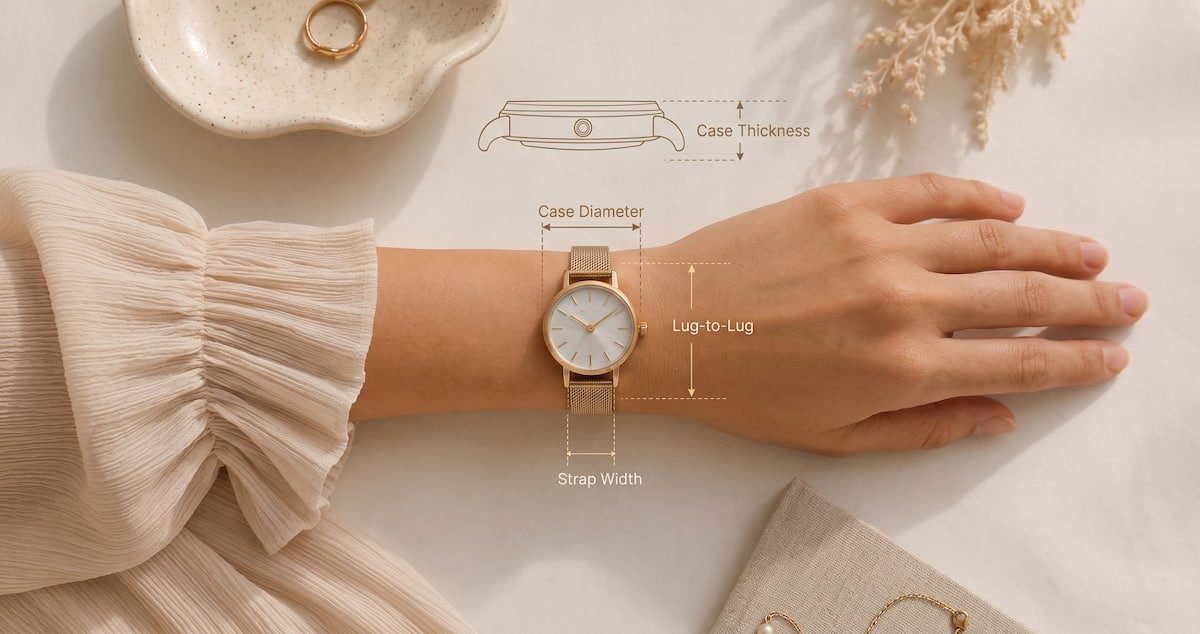
Case diameter — The width of the watch face, measured edge to edge, usually in millimeters. This is the number brands lead with, but it’s the least useful one on its own. A 30mm (1.18in) case can wear large or small depending on the case shape and lug length, which is why relying on diameter alone is one of the most common small-wrist buying mistakes.
Case thickness — How far the watch sits off your wrist, front to back, typically between 6mm (0.24in) and 12mm (0.47in). Thinner cases sit flatter and catch on sleeves less, which matters more on a narrow wrist where a thick case has less surface area to rest on evenly.
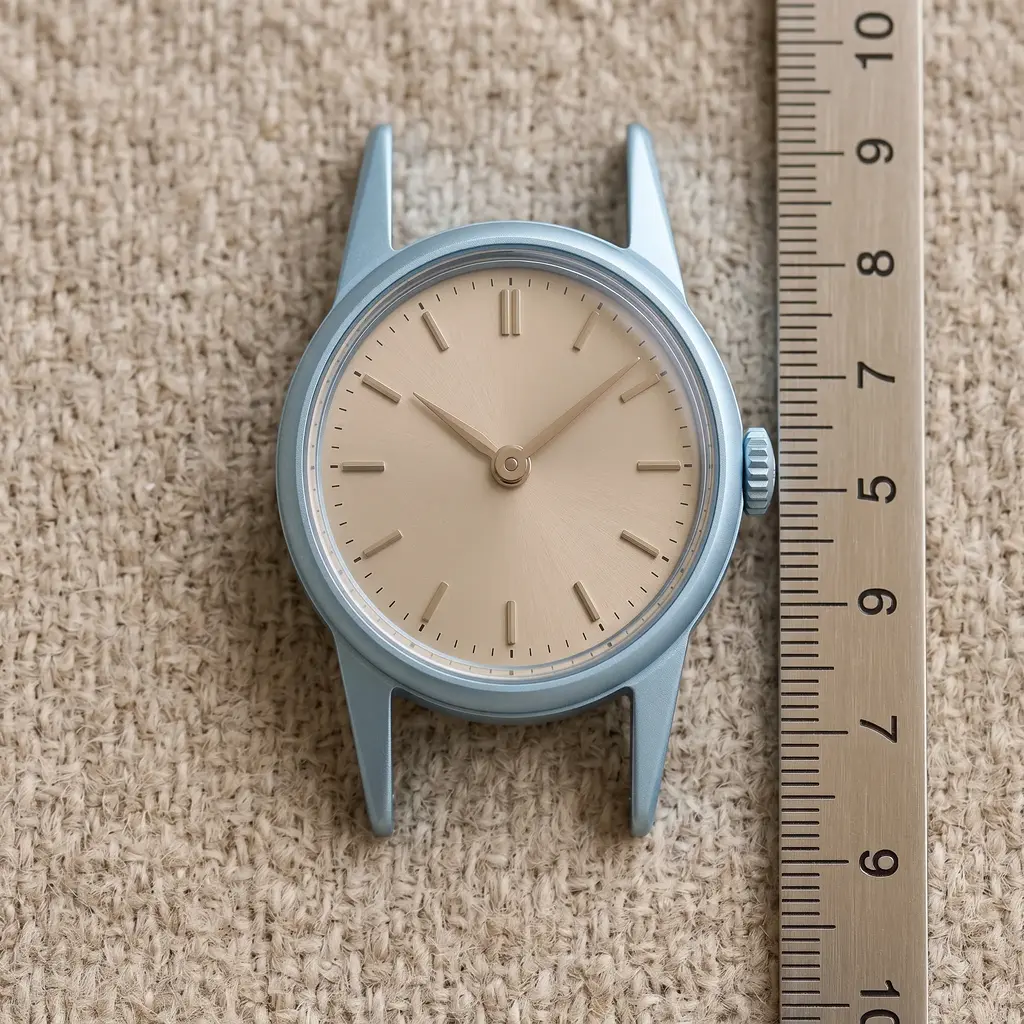
Lug-to-lug — The total length of the case from the top lug to the bottom lug, where the strap attaches. This measurement — not case diameter — determines whether a watch will overhang your wrist. A watch with a modest 30mm (1.18in) case but a long 44mm (1.73in) lug-to-lug will still hang off the edges of a 14cm (5.5in) wrist.
Bezel — The ring surrounding the watch face, sometimes fixed and sometimes rotating (common on dive watches). A wide bezel adds visual bulk without adding usable case space, which is why slim-bezel watches tend to look more proportional on smaller wrists.
Crystal — The transparent cover over the dial, usually mineral glass, sapphire crystal, or acrylic. Sapphire resists scratches best but adds a small amount of height to the case; acrylic is lightest but scratches more easily.
Why this matters: If you only remember one thing from this section, remember that lug-to-lug predicts fit far better than case diameter does. We covered this in detail in our lug-to-lug guide — if you haven’t measured your own wrist yet, that’s the place to start.
Section 2
Strap & Band Terms
Lug width — The width of the gap between the lugs where the strap slides in, usually between 12mm (0.47in) and 20mm (0.79in). Getting this measurement right matters more than any other spec if you’re shopping for a replacement strap, since a band that’s even a millimeter off simply won’t fit between the lugs. Smaller cases typically use 12–16mm (0.47–0.63in) lug widths.
Spring bar — The small spring-loaded pin that holds the strap to the case. Nearly all straps use standard spring bars, which is why most watches can accept aftermarket bands as long as the lug width matches.
Taper — How much a strap narrows from the lug end to the buckle end. A tapered strap (for example, 16mm down to 12mm) sits more naturally on a narrow wrist than a straight strap of the same width, because it doesn’t leave excess material bunching near the clasp.
Milanese mesh — A fine woven metal strap made of interlocking wire, adjustable to nearly any length via a sliding clasp. It’s a popular pick for smaller wrists because the infinite adjustability solves the common problem of standard link bracelets having gaps too large between sizing holes.
NATO strap — A single piece of fabric that loops through both spring bars and back through the buckle, originally designed for military use. It’s the most affordable way to test whether a case size works before committing to a leather or metal strap.
Section 3
Anatomy of a Watch: Parts Explained
The sizing and strap terms above will make more sense once you can picture exactly where they sit on the watch itself. Here’s a walk around the case, part by part.
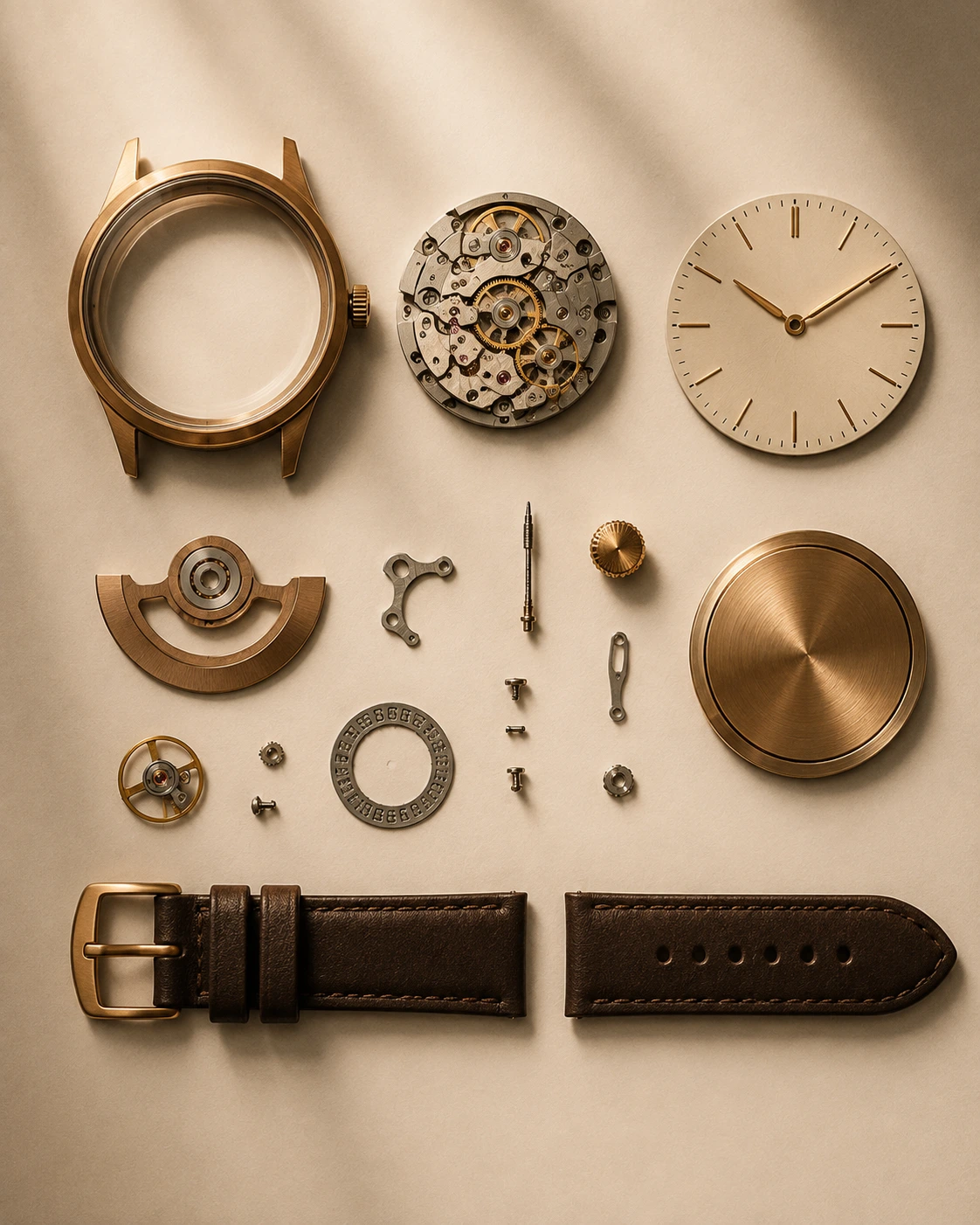
Dial — What most people just call the “face”: the surface carrying the hands, numerals, and hour markers. On a compact case there’s simply less real estate to work with, so a dial packed with sub-dials or heavy text tends to read as cluttered in a way it wouldn’t on a larger watch.
Crown — The knob on the case side used for setting the time (and, on mechanical models, winding the movement). Crown size doesn’t always scale down with the case, so it’s worth a close look at product photos — a crown built for a standard-size case can press into the wrist on a smaller one, especially when the wrist is bent.
Case back — The reverse side of the case, opposite the dial. Some are plain metal; others have a small glass window, called an exhibition case back, that lets you see the movement working underneath. Quartz watches skip this feature more often than mechanical ones, mainly because a circuit board isn’t much to look at.
Hands — The pointers that indicate hours, minutes, and seconds. On smaller dials, thinner hands read more clearly than thick, ornate ones, which can overlap and obscure the time at a glance.
Hour markers — The numerals or index marks around the dial showing each hour. Watches marketed for smaller wrists often use simplified markers (dots or slim lines instead of full numerals) specifically to avoid dial clutter.
Section 4
Movement Types & Watch Complications
Quartz movement — A battery-powered movement that keeps time using a vibrating quartz crystal. It’s the most accurate, lowest-maintenance option, and typically allows for slimmer, lighter cases — a practical advantage on a small wrist.
Automatic movement — A mechanical movement powered by the natural motion of your wrist, winding an internal rotor as you move. No battery required, but the trade-off is a thicker case to house the mechanism, and slightly less accuracy than quartz.
Manual (hand-wound) movement — A mechanical movement that requires winding the crown by hand daily, with no automatic rotor. These tend to be slightly thinner than automatics since there’s no winding rotor to fit inside the case.
Power reserve — How long an automatic or manual watch keeps running once it stops receiving motion or winding, usually 38–70 hours. If you rotate watches often, a short power reserve means resetting the time more frequently.
Complication — Any function a watch performs beyond simply showing the hours and minutes. The word comes from how much additional mechanical complexity each function adds inside the case. Wikipedia’s horology overview is a good next stop if you want to go deeper on rarer complications.
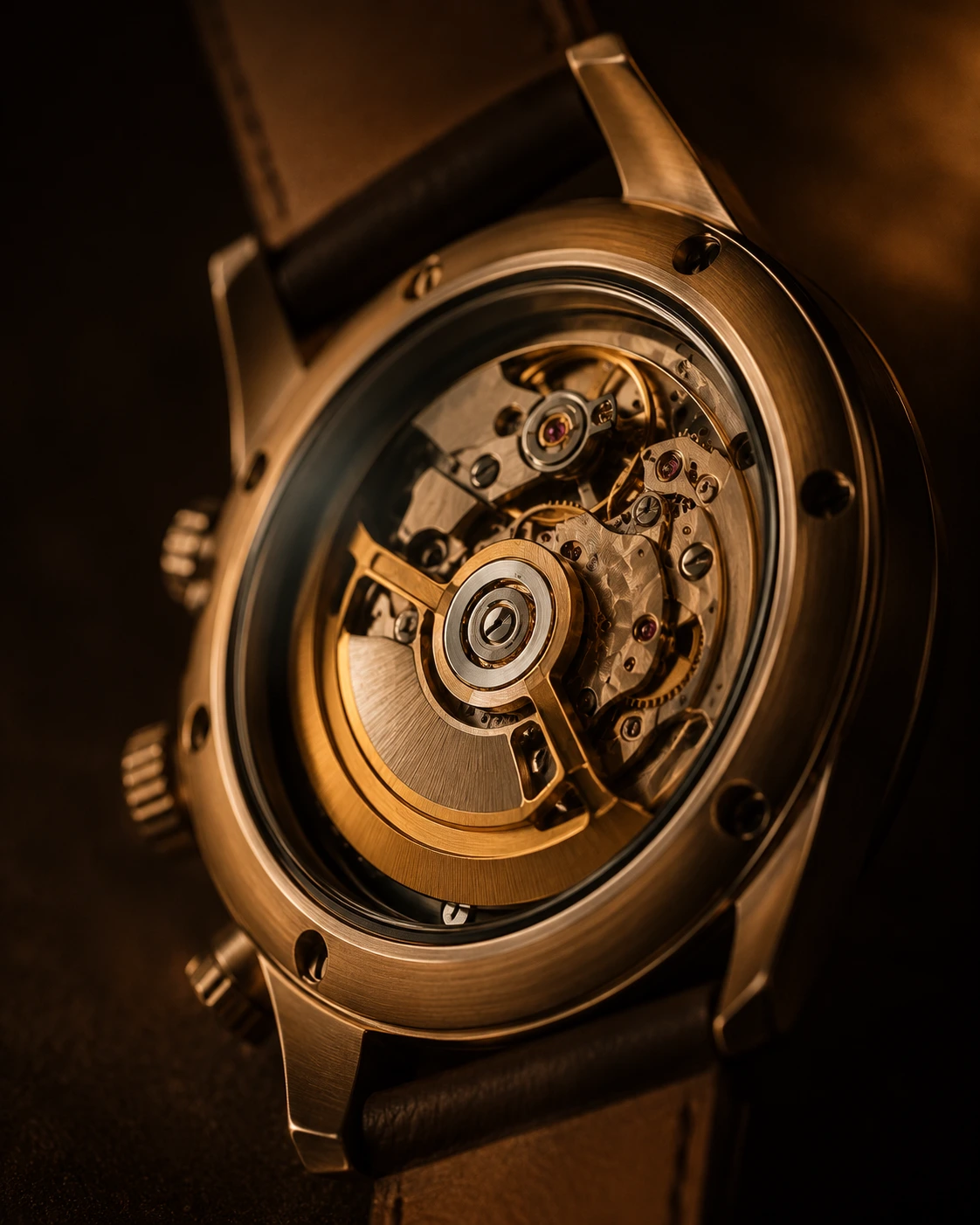
Chronograph — A built-in stopwatch function, usually operated by two extra buttons beside the crown and displayed on small sub-dials. Chronograph sub-dials take up dial space, so on a small case they can make the face feel busier than a simple three-hand watch.
GMT function — A complication that tracks a second time zone using an extra hand and a rotating or fixed 24-hour scale. Useful for frequent travelers, though the extra hand and scale add visual density to a small dial.
Day-date display — A small window, usually near the 3 o’clock position, showing the current day and/or date. One of the least visually intrusive complications, since it only occupies a small corner of the dial.
Movement accuracy — How closely a watch keeps true time, usually measured in seconds gained or lost per day. Quartz movements average within half a second per day; mechanical movements typically vary a few seconds per day, which is normal and not a defect.
Why this matters: More complications generally mean a busier, larger dial — which can work against you on a small wrist. A clean three-hand watch (hour, minute, second, no extra functions) is usually the safest choice if proportion matters more to you than features.
Section 5
Water Resistance & Durability Terms
Water resistance rating (ATM/meters) — Indicates how much water pressure a watch can handle, not how deep it can be submerged in real conditions. 30m (3 ATM) tolerates splashes only; 50m (5 ATM) handles handwashing and rain; 100m (10 ATM) or higher is needed for swimming. Wikipedia’s explainer covers why this rating is a one-time factory test, not a lifetime guarantee.
Gasket — The rubber or silicone seal inside the case back and crown that keeps water out. Gaskets degrade over years, which is why a watch’s water resistance can weaken even if the rating printed on the case hasn’t changed.
Case material — Most small-wrist watches use stainless steel, titanium, or plated alloys. Titanium is notably lighter than steel at the same size, which some petite-wrist wearers prefer since a lighter case feels less like it’s dragging the wrist down over a full day.
Section 6
Fit Terms Specific to Small Wrists
Overhang — When the case extends past the natural curve of the wrist bone on either side, usually because the lug-to-lug measurement exceeds the wrist’s flat top width. This is the single most common fit complaint on wrists under 15cm (5.9in).
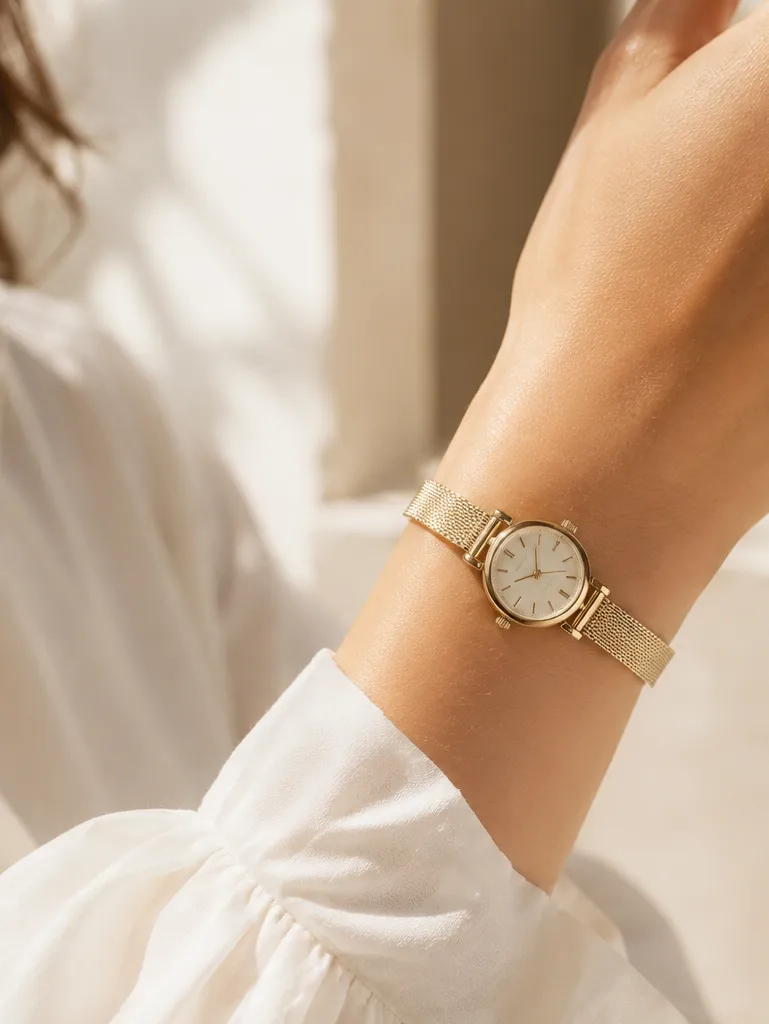
Wrist circumference vs. wrist flat width — Circumference is the full measurement around your wrist; flat width is the straight-line distance across the top where the watch actually sits, which is always shorter. Sizing charts based on circumference alone tend to overestimate how large a case will look.
Proportion — The relationship between case size and wrist size, rather than a fixed “small” or “large” number. A 32mm (1.26in) watch can look perfectly proportioned on one wrist and oversized on another, which is why we always recommend measuring your own wrist rather than copying someone else’s size choice.
Quick Reference
Watch Terms Glossary: Five Terms to Check Before Any Purchase
FAQ
Is case diameter or lug-to-lug more important for a small wrist?
Lug-to-lug matters more. It’s possible for a watch with a modest case diameter to still overhang a small wrist if the lug-to-lug measurement is long, since that number determines the watch’s total footprint on your arm.
What lug width should I look for on a small wrist?
Most watches designed for smaller wrists use a 12mm (0.47in), 14mm (0.55in), or 16mm (0.63in) lug width. Anything above 18mm (0.71in) tends to belong to a larger case that will likely also have a longer lug-to-lug.
Does a thicker case always mean better durability?
Not necessarily. Case thickness mostly reflects the movement inside — automatic movements need more room than quartz — rather than how well the watch is built. A thin quartz watch with a sapphire crystal can be just as durable as a thicker automatic one.
How do I find my wrist flat width instead of just circumference?
Wrap a flexible measuring tape around your wrist for circumference, then lay it flat across the top of your wrist bone for flat width — it will read shorter. Our full measuring guide walks through this step by step if you want a visual reference.
Do watch complications make a watch harder to wear on a small wrist?
Not harder to wear, but often harder to read at a glance. Complications like chronographs or GMT functions add sub-dials and extra hands to the same dial space, which can look cluttered on a smaller case. A simple three-hand watch tends to look cleaner and more proportional on a petite wrist.
Keep this watch terms glossary open the next time you’re comparing watches — whether you’re reading our reviews or a listing anywhere else. The terms don’t change from brand to brand, and now neither does your ability to tell, before you buy, whether a watch will actually fit.