
Women’s Watch Guide
The Sizing Guide Nobody Told You About
Small wrists · Case diameter · Lug-to-lug · Hand shape · Case geometry
You found a watch online. Case diameter: 32mm — well within the “safe” range for small wrists. It arrives. You strap it on. It looks like a hubcap.
This happens because most sizing guides reduce the problem to a single number. Case diameter is the most marketed spec and the easiest to compare — but it tells you almost nothing on its own about whether a watch will actually fit. A well-fitting watch is the result of five or six variables working together. Get any one of them badly wrong and the case diameter doesn’t matter.
What actually counts as a small wrist?
A wrist between 14 and 16 cm in circumference is generally considered small to petite. Below 14 cm is very petite, and below 12.7 cm (5 inches) is exceptionally fine-boned. These are circumference measurements — the distance all the way around your wrist, not the flat width across it.
Wrist width — the flat diameter of your wrist — is what directly constrains how a watch sits. To find yours, divide your circumference by π (3.14). A 15 cm circumference gives you approximately 47–48 mm of width. That single number is more useful than any manufacturer’s size recommendation.
| Circumference | Wrist width (÷ π) | Case sweet spot | Character |
|---|---|---|---|
| Under 14 cm | Under 45 mm | 24 – 28 mm | Very petite / fine-boned |
| 14 – 15.5 cm | 45 – 49 mm | 28 – 34 mm | Petite / small |
| 15.5 – 16.5 cm | 49 – 53 mm | 32 – 38 mm | Small / standard |
| 16.5 – 17.5 cm | 53 – 56 mm | 34 – 40 mm | Standard |
Wrap a soft tape (or a strip of paper) snugly around your wrist just below the wrist bone. Note the number in centimetres. Measure twice — once in the morning, once in the afternoon — wrists fluctuate by 2–3 mm with temperature and activity. Average the two readings.
The proportion rule
Why case diameter is only the starting point
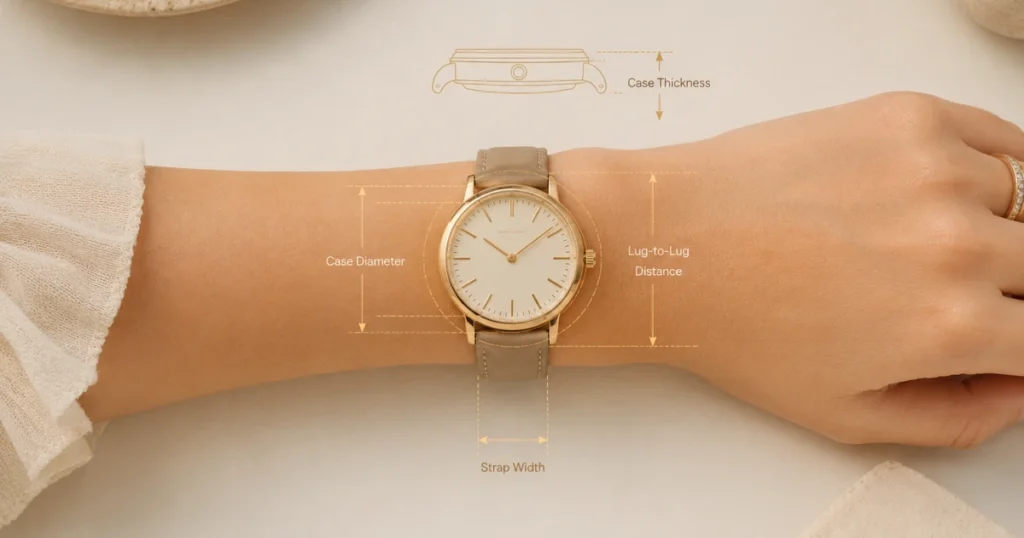
Diameter measures the width of the watch face. Two watches with identical case diameters can look completely different on the wrist because the dial design, hand shape, case profile, and lug structure all change how large a watch appears in practice.
The proportion rule gives you a reliable benchmark: the case diameter should cover roughly 40 to 55 percent of your wrist width for a balanced, timeless look. Below 40 percent the watch reads as fine jewellery; above 65 percent it begins to overhang the wrist edges.
| Coverage | Category | What it means on the wrist |
|---|---|---|
| Under 40% | Delicate | Reads as fine jewellery — minimal visual presence, extremely refined |
| 40 – 55% | Perfect fit | Balanced and proportional — a timeless, polished choice |
| 55 – 65% | Bold look | Oversized style — slightly extends past wrist edges, confident and modern |
| Over 65% | Too large | Hangs over the wrist edges — uncomfortable and visually imbalanced for most |
Treat this as a starting framework, not a hard rule. Case shape, profile, dial design, and hand style can shift how large a watch appears by the equivalent of several millimetres — which is why this guide doesn’t stop here.
Lug to lug
Lug-to-lug: the number most guides skip
The lugs are the four projections at the top and bottom of the case where the strap attaches. The lug-to-lug distance — from lug tip to lug tip along the length of the watch — is what physically spans your wrist. It determines whether the watch curves naturally against your skin or bridges rigidly across it.
Two watches can share identical case diameters and sit completely differently because their lug designs are opposite. Extended lugs that project horizontally cause the watch to lift off the wrist centre, making it tilt throughout the day. Compact lugs that angle downward hug the wrist curve and feel noticeably lighter to wear.
When shopping online, check the full specification listing for lug-to-lug. If it’s missing — which is common with fashion and entry-level watches — search for forum reviews or look up the reference on a watch database that lists complete dimensions. A practical target: lug-to-lug close to, or slightly less than, your wrist width.
Case shape
How case geometry changes the look
Case shape — and case profile — alter the visual weight of a watch independently of its stated dimensions. A rectangular case can wear smaller than a round one of identical diameter because vertical lines read as slimming. A thick domed profile adds perceived size; a flat case under 8 mm disappears against the wrist and reads as lighter than it is.
| Case shape | L2L tendency | Effect on small wrists | Examples |
|---|---|---|---|
| Round | Varies widely by lug design | Most forgiving; follows wrist curve naturally when lug angle is good | Most watch designs |
| Rectangular / Tank | Short — well suited | Reads narrower than its mm size; vertical lines slim the silhouette | Cartier Tank, Longines Mini DolceVita |
| Tonneau (barrel) | Short to medium | Organic curve echoes the wrist naturally; underrated for petite wrists | Vintage Omega, Longines Evidenza |
| Cushion (rounded square) | Medium | Bold but contained; sporty feel without the visual weight of a round case | Vintage Seiko, some sport-dress pieces |
| Oval | Very short | Ultra-feminine; flows along the arm direction and rarely overhangs | Ladies’ dress watches, vintage pieces |
Case thickness is its own variable. Anything under 8 mm sits flush and doesn’t catch on cuffs. A domed or tall profile above 10–11 mm will physically snag on sleeves and reads as larger than a flat case of identical diameter. If you prioritise a delicate look, profile matters as much as footprint.
Hand shape
The hand shape nobody talks about
The profile and weight of the hands change how a dial reads at a glance. Delicate pencil hands on a clean dial keep the whole composition light. Bold cathedral or sword hands on the same case read as significantly heavier. This is not a stylistic opinion — the difference in visual weight is measurable in the equivalent of several millimetres of case size.
| Hand style | Visual weight | Character | Pairs best with |
|---|---|---|---|
| Pencil | Very light | Ultra-slender taper; nearly disappears into the dial | Fine dress watches, ultra-thin profiles, gold cases |
| Baton / Stick | Light | Simple rectangle; clean, quiet, unassuming | Minimalist dials, Scandinavian and fashion watches |
| Dauphine | Light–medium | Faceted ridge catches light; refined without adding bulk | Classic dress and polished everyday watches |
| Alpha / Leaf | Medium | Lens-shaped swell; organic, warm, vintage in character | Vintage-inspired, Art Deco, romantic dress pieces |
| Spade / Paddle | Medium–bold | Spade-tip flare; highly legible, sits between sporty and dressy | Dress-sport, pilot-style, casual-elegant pieces |
| Sword | Bold | Broad base tapering sharply; assertive and sport-oriented | Field, sport, statement watches |
| Cathedral | Bold | Recessed centre channel; architectural, dramatic, prestige-coded | Grand complications, collector and high-end sport pieces |
Hand style also interacts with dial density. A minimalist dial paired with light baton or pencil hands maximises open space and reads as smaller. A dense dial (subdials, heavy indices, printed text) amplified by bold hands compounds the visual weight. When a dial is already busy, lighter hands create breathing room; on a very clean dial, bolder hands can add welcome presence without overwhelming.
Dial & strap
Dial density, colour, and the strap factor
A simple dial — open space, thin indices, minimal printing — allows the eye to move past the watch face. A complex chronograph or heavily printed dial pulls the gaze in and holds it. On a small wrist, choosing a cleaner dial on a slightly larger case often results in a more proportional outcome than picking a complex dial on a smaller case.
Dial colour has a quieter effect: light dials (white, cream, silver) reflect light outward and read slightly larger; dark dials (black, navy, forest green) absorb light and read as more contained. This is partly why dark-dialled watches often wear visually smaller than their stated dimensions suggest.
The strap is the easiest variable to get wrong and the cheapest to fix. A strap that is too wide for the case creates a bottom-heavy, unbalanced look. A rough starting point: strap width at roughly half the case diameter — a 30 mm case pairs naturally with a 14–16 mm strap. Beyond width, material adds or subtracts visual weight: wide rubber and nylon read as bulkier; slim leather or fine milanese mesh sit flat and quiet on a narrow wrist without competing for attention.
Putting it together
Six factors that need to agree with each other
Rather than looking for “the right case diameter,” think of watch fit as a combination of variables. Get five of six right and the one you miss can still throw off the whole composition. Here is what to check, roughly in order of impact:
A 36 mm watch with compact lugs, a flat profile, a clean dark dial, pencil hands, and a slim leather strap can wear more elegantly than a 28 mm watch with extended lugs, a domed thick case, and a busy chronograph face. The diameter alone tells you nothing without the rest.